
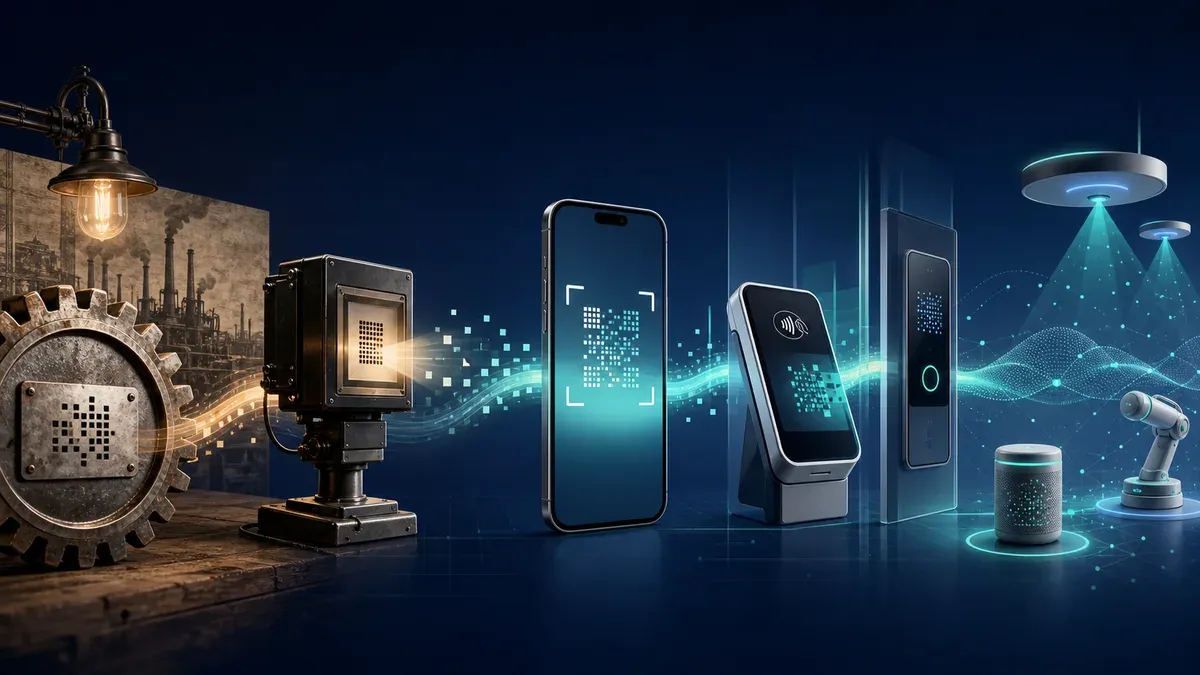
The History and Future of QR Code Technology

Introduction
Billions of QR codes are scanned every day — on restaurant tables, product packaging, billboards, passports, and payment terminals. The technology is now so ubiquitous that most people never stop to wonder where it came from. The answer involves a Toyota supplier, a frustrated engineer, and several decades of the world slowly catching up to an invention that arrived decades before the infrastructure to support it existed.
1994: Invented in a Toyota Parts Factory
The QR code was invented by Masahiro Hara, an engineer at Denso Wave, a subsidiary of Toyota. The problem Hara was solving was mundane but important: barcode scanners at automotive parts factories were slowing down production lines.
Each part required multiple scans across several different barcodes to capture all the relevant information. Hara’s team needed a single code that could hold far more data than any existing barcode format — and be read quickly even at odd angles on a moving assembly line.
After experimenting with numerous 2D patterns, Hara settled on a square matrix design with three distinctive corner squares (the finder patterns). These allow a camera to instantly locate and orient the code regardless of the viewing angle.
The name QR stands for Quick Response — a reference to the sub-100ms decode time Hara designed for.
Denso Wave published the QR code specification as an open standard in 1994, making it free for anyone to use. This decision, unusual for the time, would prove to be one of the most consequential choices in the technology’s history.
1999–2009: Japan’s Mobile Internet Era
Japan had high-speed mobile internet before most of the world. By the early 2000s, Japanese consumers were using QR codes on product packaging, in magazines, and on television advertisements to link to websites and download content directly to their feature phones.
NTT DoCoMo popularized the format by integrating QR scanning directly into its mobile phones. Japanese consumers grew accustomed to scanning codes years before smartphones existed.
Outside Japan, however, QR codes saw minimal adoption. The infrastructure simply wasn’t there: scanning required a third-party app, mobile internet was slow and expensive, and smartphone screens had not yet become standard.
2010–2017: The First Wave of Western Hype — and Failure
The launch of the iPhone (2007) and the Android ecosystem created the platform QR codes needed. Marketing agencies in the US and Europe immediately began embedding QR codes in print ads, product packaging, and bus shelter advertisements.
The result was, by most measures, a disappointment. Usage surveys consistently showed that only a small fraction of people who saw a QR code in an ad ever scanned it. The friction was too high: users had to unlock their phone, open an app store, download a QR reader, open it, then scan. Most didn’t bother.
By 2017, technology commentators were declaring QR codes dead.
2017–2019: The Comeback Begins
Two developments quietly reversed the trend.
First, Apple added native QR scanning to the iPhone camera app in iOS 11 (September 2017). Users no longer needed a separate app — they pointed the camera at a code and a notification appeared. Google added equivalent functionality to Android soon after.
Second, QR code payments exploded in China. Alipay and WeChat Pay had made QR-based payments universal in Chinese cities. By 2019, the model was spreading to Southeast Asia, India, and Latin America. QR codes were no longer a marketing gimmick — they were payment infrastructure.
2020–2022: The Pandemic Accelerator
The global shift to contactless interaction during 2020 accomplished in months what years of marketing had failed to do: it made QR code scanning a universal behavior.
Restaurant menus became QR codes overnight. Check-in systems, health pass verification, event tickets, boarding passes, and contact tracing apps all relied on QR codes. A significant portion of the global adult population scanned their first QR code during this period — and kept scanning afterward.
Usage data from 2022 showed that QR code scans had increased by over 400% compared to pre-2020 levels and continued growing.
2023–Present: Infrastructure, Not Marketing
The current phase of QR code adoption is defined by integration into serious operational infrastructure rather than marketing campaigns.
- Digital passports and identification documents in multiple countries embed QR codes for machine-readable verification
- Central bank digital currencies (CBDCs) in several pilot programs use QR codes as a primary payment interface
- Healthcare systems use QR codes on patient wristbands, medication packaging, and test result notifications
- Industrial IoT applications use QR codes on equipment for instant access to maintenance records and operational data
The Future of QR Codes
Encrypted and authenticated QR codes are already emerging. Rather than linking to a URL, these codes contain a cryptographically signed payload that cannot be forged — enabling use cases like digital identity verification and document authenticity without requiring network connectivity.
Dynamic QR codes (where the destination URL can be updated after the code is printed) are becoming standard for marketing and operational uses, enabling real-time redirects, A/B testing, and analytics.
Augmented reality integration is being tested by several platform providers — scanning a QR code triggers an AR overlay rather than a webpage, enabling new experiences in retail, education, and navigation.
Why Web-Based Scanning Matters
As QR codes become more critical infrastructure, the scanning experience matters more. Tools that require app downloads, create accounts, or upload your images to servers add friction and create privacy risks that are increasingly unacceptable.
Browser-based scanning — the model used by Web QR Scan — processes everything locally without installation or data transmission. As QR codes encode more sensitive information (medical records, financial data, identity documents), local processing is not just a convenience — it is the appropriate security posture.
Conclusion
Thirty years after a Toyota engineer invented it to speed up a car parts assembly line, the QR code has become one of the most widely used data formats in human history. Its open standard, its resilience, and its adaptability have made it infrastructure rather than a trend — and it shows no signs of being replaced anytime soon.