
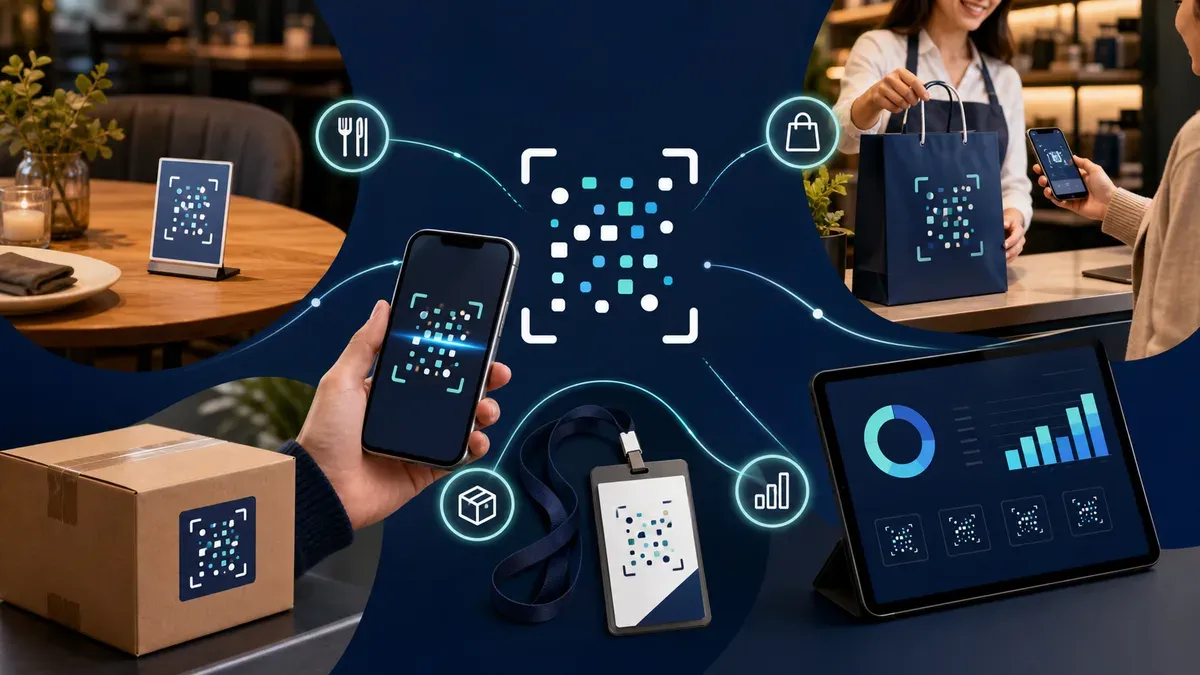
10 Ways Businesses Are Using QR Codes in 2026

Introduction
QR codes quietly disappeared from mainstream use for most of the 2010s — and then came roaring back. The global shift to contactless interactions accelerated adoption dramatically, and businesses that integrated QR codes during that period never went back. In 2025, QR codes are embedded in marketing, operations, payments, and customer service workflows across every industry.
Here are ten concrete ways businesses are using them today.
1. Contactless Restaurant Menus
This remains the most visible adoption. Restaurants replaced printed menus with a single QR code on the table — customers scan to view the current menu, which the restaurant can update in real time without reprinting. Wine lists, daily specials, allergen information, and translated menus all live behind the same code.
The advantage beyond COVID-era convenience: menus are now searchable, linkable, and updatable within minutes of a supplier change.
2. Mobile Payments and Digital Wallets
QR code payments (popularized in Asia by Alipay and WeChat Pay, now standard on Apple Pay and Google Pay) allow a customer to scan a merchant’s QR code to complete a payment without card terminals or cash. For market stalls, pop-up vendors, and informal businesses, a printed QR code is their entire payment infrastructure.
In 2025, QR-based payment processing fees are typically lower than card-present rates, making it attractive for small businesses.
3. Product Authentication and Anti-Counterfeiting
Luxury goods, pharmaceuticals, and electronics manufacturers embed unique QR codes at the unit level. Consumers can scan to verify a product’s authenticity — the code resolves to a certificate of authenticity stored in a tamper-evident ledger. Counterfeit products either fail to scan or resolve to a flagged database entry.
Brands like LVMH and several pharmaceutical distributors have built consumer-facing product verification portals accessible via QR scan.
4. Inventory and Warehouse Management
Warehouse teams use QR codes on shelving, bins, and individual items to enable rapid inventory counts and movement tracking. A worker with a smartphone can scan a QR code to log an item’s location, flag it for picking, or update stock levels — no dedicated barcode hardware required.
QR codes carry more data than traditional 1D barcodes, enabling a single code to encode both the product SKU and location reference simultaneously.
5. Event Check-In and Ticketing
Paper tickets are almost gone. Event QR codes serve as admission tickets, are checked in under a second by scanning staff, and are invalidated immediately after first use to prevent sharing. Conference badges, venue access passes, and airline boarding passes all use the same mechanism.
Organizers benefit from real-time attendance data rather than counting paper stubs at the end of the day.
6. Marketing Campaigns with Trackable Links
Printed ads, billboards, packaging, and direct mail materials include QR codes that link to campaign-specific landing pages. Each campaign uses a unique short URL, so the marketing team can measure exactly how many scans came from a particular poster location, magazine issue, or product box.
This closes the measurement gap that traditionally separated offline and online marketing attribution.
7. Customer Loyalty Programs
Physical loyalty punch cards are being replaced by QR code-based programs. Customers scan at checkout to earn points, and the same code can deliver a personalized offer based on purchase history. No plastic card to lose, no app to download — just a QR code sent to their email or printed on a receipt.
8. Wi-Fi Access for Guests and Customers
Cafés, hotels, and co-working spaces display QR codes that encode their Wi-Fi network name and password. Guests scan once and connect instantly — no staff intervention, no whiteboard with a scrawled password, no typing errors.
This also improves security: when the password rotates, only the QR code needs updating.
9. Product Packaging and Extended Information
A physical product box has limited surface area for information. QR codes on packaging link to installation guides, user manuals, video tutorials, warranty registration, recycling instructions, and compliance certificates — all keeping the printed packaging clean while providing buyers with everything they need.
IKEA, consumer electronics brands, and food manufacturers all rely on this to reduce printing costs and localize content without producing separate packaging per market.
10. Internal Operations: Maintenance and Asset Tracking
Manufacturing plants and facilities management teams place QR codes on equipment, HVAC units, fire extinguishers, and electrical panels. Maintenance technicians scan a code to pull up the asset’s service history, log a completed inspection, or submit a fault report — directly from their smartphone, in the field, without paperwork.
This builds a verifiable maintenance log tied to each physical asset rather than a spreadsheet that exists separately from the equipment itself.
Scanning QR Codes Without Installing Anything
For businesses deploying QR codes, a common friction point is the end user’s willingness to scan. If your audience expects to need a dedicated app, some will drop off before scanning.
Browser-based scanning removes that barrier entirely. Users on any device — iPhone, Android, or desktop — can open webqrscan.com in their existing browser and scan immediately. No app download required.
Conclusion
QR codes have moved well beyond a novelty or pandemic-era workaround. They are a durable, flexible, and low-cost infrastructure layer connecting physical touchpoints to digital workflows. For businesses that have not yet integrated them into operations, the question is not whether to adopt QR codes — it is which workflows to start with.